
Showing posts with label Catching. Show all posts
Showing posts with label Catching. Show all posts
Tuesday, November 15, 2011


Friday, September 9, 2011
Tuesday, September 6, 2011
Wednesday, August 24, 2011
Thursday, August 18, 2011
Tuesday, July 26, 2011
Monday, July 18, 2011
Saturday, July 16, 2011
Saturday, June 11, 2011
Friday, June 3, 2011
Tuesday, May 3, 2011
Monday, April 25, 2011
Collisions at home plate
The following clip shows you all you need to know about the potential danger of collisions at home plate.
I’m sure many a catcher has woken up in a cold sweat after dreaming of Bo Jackson or Prince Fielder bearing down at them at home plate. This type of play has the potential for serious injury for a variety of reasons. The top one being that the catcher is somewhat stationary and the runner is traveling at full speed. In addition, the catcher’s eyes have to be on the ball/throw and can lead to a catcher being blindsided by the runner. Because of these significant dangers, there are some very important safety tips catchers need to implement in order to protect themselves as much as possible and make the play as well.
 |
| A forearm to the face is a great reason for keeping the mask on. |
Point your toes/knee at the runner. When a throw is coming from the centerfield or right field area, the left side of the catcher’s body is facing the runner coming down the line. A catcher MUST point his left foot and knee at the runner who is coming at him. This does two things: 1) It faces the shin guard at the runner and protects his left leg should the runner’s spikes hit the leg on the slide, and more importantly, 2) the side of the catcher’s left knee does not get hit by the runner. When the side of the catcher’s knee gets hit on this play, it has the potential to result in a major, career ending injury to the knee. A leg that gets hit from the front may still result in an injury (hyperextension) but it normally won’t be as severe as getting hit on the side.
Give the runner some space. When you watch a play at home plate on TV, you will see that the catcher usually provides a space or lane for the runner to get to home plate on a slide. When a runner sees this space, he is more likely to slide. If the catcher is totally blocking the plate, the runner is more likely to slam into him because there is nowhere else to go. If a catcher receives the throw early enough, he can then step back to block that area from the runner and apply a tag. Blocking the entire plate without the ball usually invites a collision.
Stay low. Whenever possible, a catcher should stay as low to the ground as he can on a play at the plate. Think of the biggest hits in football. Usually they involve a player with the ball who is upright and a tackler who drops his shoulder and plows through the guy with the ball. Catchers want to avoid this situation if they can. A catcher can be a sitting duck on this play so staying lower than the runner prevents a runner from dropping his shoulder underneath the catcher and really drilling him. Unfortunately, the catcher cannot control the throw he is given. Some throws will be high and/or up the 3rd base line a bit which forces the catcher to remain upright to catch the ball. A catcher just does what he can to stay low.
 |
| Lower than the runner, left toe and knee facing the runner, mask on, and drops his butt to the ground on impact. |
Other important tips:
Don’t assume. At many amateur levels, a collision at the plate is an illegal play and can result in immediate ejections. Of course, this is due to the potential for injury. However, a catcher should NEVER assume the runner is going to slide like he is supposed to. Sometimes a runner has every intention of sliding until the last moment when the competitive side to him comes out and he just temporarily loses his mind. A catcher must prepare for the worst no matter what the rules say.
Don’t get angry. When a catcher gets “smoked” by a runner at the plate, the best thing a catcher can do is just get up and react as if nothing happened, especially if the runner is out. Many young catchers will come up angry and go after the runner to confront him. Very immature. React as if it had no effect on you at all and you will earn a lot of respect from both teams and others who are watching. Of course, if a catcher is actually hurt on the play, nobody would expect him to just get up and carry on as normal.
Practice. Because this play is a rare one in baseball, many catchers do not practice the fundamentals of this play very often or at all. A catcher should practice getting throws from different parts of the field and apply tags with the correct body position. A runner or coach can move down the line when the throw comes in and “collide” with the catcher by just shoving the catcher back with his hands. This “controlled collision” allows the catcher to practice all the tips listed and explained above.
A collision at the plate is usually not a very fun play for a catcher but it certainly is part of the job description.
Friday, April 1, 2011
Interview with Coach Barksdale - Univ. of Louisville

As an assistant coach at the college level, I’m sure you do a lot of recruiting. As a coach of catchers, what area(s) of the high school catcher do you most often have to correct when a player gets to Louisville?
Being at a high level program like Louisville, we have the opportunity to recruit catchers who already have most of the basics down before they arrive. Probably the biggest area I work on with young catchers is throwing and developing arm strength. Most young catchers are not aware of how much throwing catchers do at the college level and have to train their arms to prepare for that. Most catchers we get at Louisville still have a lot of arm strength to gain so we immediately put them into a long-tossing program that is geared to maximizing arm strength. Other than that, I find that many catchers coming into the college level need work on the mechanics of tag plays at home plate and catching pop-flies over home plate. Plays at the plate can be very dangerous for catchers if they are not in the proper body position so I make sure all my catchers are clear as to how it should be done. Pop-flies around the plate area have to be automatic outs at the college level. That’s a play that is often mishandled by high school catchers but it can’t happen in college. It has to be an out.
There are a lot of myths in baseball when it comes to baseball instruction. What do you see as the biggest myth associated with catching?
What comes to mind is something I hear a lot when catchers drop a ball. You often will hear someone from the stands or the dugout say “Squeeze it!” when that happens. The problem wasn’t that the catcher didn’t squeeze the ball. The problem is that the catcher caught the ball with the wrong part of the glove. Most of the time, the catcher tried to catch the ball in the palm area of the glove. A catcher should always catch the ball in the “pocket” of the glove which is the area between the index finger and the thumb. When a catcher does this, he won’t need to squeeze the glove. Catching it in the pocket closes the glove around the ball naturally.

It’s called the Catcher’sThumb. It’s a hard piece of plastic that a catcher wears around the thumb that fits into a catcher’s mitt. Most catchers at the pro level have them but the material that is most commonly used to make them is only available to high level athletic trainers. I created the Catcher’s Thumb to give all catchers the ability to have one and the benefits from using it.
On Baseball By The Yard I’ve written a number of posts about the concept of "make-up." How important is a catcher’s make-up in your decision to recruit him?
It plays a huge role. A catcher has to be able to connect with the players on the team especially the pitching staff. Leadership qualities among catchers are a must at my level. I look for a guy that knows when to pat a pitcher on the back and when to get in his face. That takes a certain personality to pull that off effectively. Handling pressure is also important. Catchers have to make very quick decisions in pressure situations so it’s important for them to not just know what to do but to do it when it’s needed the most.
Anyone can see a catcher hit a 400ft home run or one that has a canon for an arm and label that kid a prospect. However, as you know, success at the higher levels has a lot to do with the little things most fans don’t notice. What little things do you look for when you watch catchers?
Most of what I’m looking at has to do with receiving. There is a difference between “catching” and “receiving.” Receiving means catching the ball with very little movement and “strong hands.” Strong hands means the ability to keep the ball where you catch it instead of allowing the ball to move the glove away from the zone after catching it. That’s an important part to receiving because the catcher does not want to take strikes away from the pitcher by moving his glove too much after the catch.
Other than that, I’m looking for what coaches refer to as “having life in your feet.” That means always hustling on every play and bouncing around as if you want to be there. It’s easy for a catcher to get worn down but the good ones never show that fatigue.
Living near Philadelphia, I hear the Phillies’ pitchers often say that they love throwing to Carlos Ruiz. What makes a catcher so popular with pitchers?
 |
| Carlos Ruiz (Photo by Christian Petersen/Getty Images) |
It starts with the basics like receiving well and getting more strikes for the pitcher along with being a good blocker on balls in the dirt. After that, it goes back to connecting with pitchers. Pitchers like to get into a rhythm and every time they have to shake off a catcher’s sign it slows down that rhythm. Having a catcher who is on the same wave length as pitchers is certainly a plus. A great catcher knows that every pitcher is unique in terms of their pitches and personalities. Spending time with them in the bullpen, the dugout, and the clubhouse helps catchers get to know each pitcher and what makes them tick.
Many young catchers have all the pitches called for them by the coaching staff. What are your thoughts on catchers being able to call their own game?
Calling your own pitches can be a great developmental tool for catchers. It’s a great way to learn the game because you have to be aware of many factors happening at once to know what pitch to put down. However, there are times when the coaches are more aware of the scouting report than the players so in that case we’ll relay the signs. Especially if the pitcher/catcher combination is young. If the pitcher and/or catcher have more experience, we generally give them more flexibility to call more of their own pitches. At Louisville, we try to have a balance of the two.
 |
| Yadier Molina |
Probably Yadier Molina of the St. Louis Cardinals. Not only does he have great fundamentals in terms of throwing, blocking, and receiving mechanics, he has the quickness you want to see in a catcher and a good feel for the pitchers he works with. It’s clear the pitchers have a lot of respect for him. Many major league catchers have such great physical skills and athletic ability that they can get away with mechanical shortcomings. Yadier Molina combines a natural athletic ability with good mechanics. He comes from a family of great catchers (his two brothers are also MLB catchers) so he’s had some great instruction. He’d be my pick.
A number of Major League catchers did not start their career as a catcher. Carlos Ruiz actually started in pro ball as an infielder. What would you see in a player that would lead you to believe that his career should be behind the plate?
Many times the players that are converted into catchers are guys who have a pretty good bat but are a little short in the area of defense. A good bat forces coaches to find another spot for the guy to get him into the line-up. Middle infielders are good candidates for this because they usually have developed some skills that transfer well to catching. Soft hands, quick hands with the catching and throwing transition, quick footwork, and what I mentioned earlier – “life in their feet.” If an infielder no longer can handle the defensive requirements of their position, they might have enough of those skills to make the jump to catcher.
Catching is probably the most grueling position on the field and can wear down a body quickly during the season. What do you encourage catchers to do to keep their bodies healthy during the season?
Many people focus attention on the wear and tear catching can take on the knees. As I said earlier, young catchers usually don’t understand the toll that catching can have on the arm because of the amount of throwing required. A pitching staff may throw 100-200 pitches per game. People forget that the catcher makes a firm throw back every time. That’s up to 200 throws a game in some cases for the catcher. Add to that return throws when the pitcher makes his pre-inning pitches plus the pre-inning throws the catcher makes down to second base. That’s a huge amount of throwing. Unfortunately, the catcher doesn’t get four to five days off in between starts like pitchers do to allow their arm to recover. At Louisville, we put our catchers on a “pre-hab” program of tubing exercises, ice, and cardio work very much like pitchers to keep their arm strong throughout the season. Cardio work would involve a routine of light pole running and some light stationary bike work. A pitcher can run hard poles and do hard bike work because they have days to recover. A catcher is back out there the next day so they do the same exercises as pitchers but they just take it a bit lighter.
You were fortunate to play a high level Division I college program (Ole Miss.) and at the pro level (Atlanta Braves Organization) as well. At what level did you learn the most about catching?
I was fortunate that as a youth catcher my parents made every opportunity available to me. I had the opportunity to workout with a Division I catcher (Barry Winford) who played at Mississippi State University and ended up playing in the Texas Rangers organization. I also attended numerous baseball camps/clinics. My head coach at Ole Miss (Mike Bianco) and the various Atlanta Braves catching instructors were also very knowledgeable so I got very good instruction throughout my playing days. Another thing that I did that I always tell kids and coaches to do in my clinics is to study good catchers that you see. The advantage catchers have is that when you watch TV, the catcher is always in full view. You can see everything he does from giving signals to receiving to throwing and blocking. From start to finish, you see everything. If I’m a left fielder, I only get to see the end result on TV – the catch. I miss the pre-pitch steps, the first step footwork, and the angle to the ball. You don’t miss much if you watch a catcher. Of course, this requires a kid to study the catcher instead of just watching the game. There’s a lot to see if you really pay attention.
Your website has a great deal of valuable information for catchers. What inspired you to create your website?
As I said, I was fortunate that I was able to receive some great instruction due to the people I had access to. That’s not the case with most kids. When I looked around, there was very little good information for catchers on how to do things correctly. My website (www.catching-101.com) is my attempt to give tons of valuable information to those kids that are not as fortunate as I was.
I saw on your site that you have a book coming out soon. What is it about and what is the status of it?
My book on catching, that will be available at www.catching-101.com, is an expansion of much of the information I have provided on my site and in my videos. For example, in my videos I show a lot of good drills for catchers but the book will get into much more detail about how to actually do them correctly. Although it is more geared to the high-amateur level catcher, it certainly would be valuable for any catcher, parent, or coach who wants to learn about every aspect of catching. It’s a combination of my thoughts on catching and proper technique.
I am hoping to get the book finished and published within a couple months. It’s been tough since my coaching position takes up a lot of time but it should out in a few months.
You’ve also come out with an iPhone app. What kind of app is it?

Baseball By The Yard would like to thank Coach Barksdale for taking the time to do this interview. We wish him and the rest of the University of Louisville Cardinals the best of luck in their 2011 season!
To get all the great instruction and products from Coach Barksdale, be sure to check out the following links:
Website: www.Catching-101.com
Catcher’s Thumb: www.CatchersThumb.com
Catching 101 Book: www.catching-101.com/Catching-101/Book.html
Catcher’s Performance Summary App – www.CatchersPerformanceSummary.com
Wednesday, March 23, 2011
The silent catcher
For every position or role on the field there are a given set of expectations for a player, should he want to be successful. The nature of the lead-off spot in the order demands that a player be good at getting on base. A third or fourth hitter should have a greater ability to drive in runs. A shortstop should have enough arm strength to make a throw from the hole. A pitcher has to be able to throw multiple pitches for strikes. All these expectations have to be met if the player in that role wants to be successful.
But what about things like leadership? Do you have to be a good leader to be a successful second baseman? How about a left fielder? It would be a nice addition to players in those roles but I would argue that it's not a necessity.
That's not the case for catchers.
The very nature of being a catcher demands that they be a leader on the field. A player who catches cannot look at the leadership expectations as optional. It is part of the job just like it's part of the job description of a lead-off hitter to get on base. When you catch, the whole field is in front of you. You see everything. You are also closest to the coaching staff in the dugout so you become the link between the coaches and the players in front of you. Whether he likes it or not, a catcher is a leader and needs to act like one.
Many young players connect being a leader with being an in-your-face, rah-rah type of kid. Although that tends to be the leader that is most easily noticed, there are other styles of leadership. There have been many successful catchers who were soft-spoken and wouldn't come across as being an outgoing, stereotypical leader-type individual. However, when they put their uniform on, they became a leader in one form or another. Some bark out reminders constantly during the game and let their pitchers know they are not pleased with their performance either verbally or through body language. Others have the calm, cool, confidence of someone who knows they are in charge but doesn't need to prove it all the time. Their style is better in a one-on-one setting. The common denominator in both personality types is leadership in some form.
If you are a catcher and want to be good, embrace your leadership role and match the leadership style that works with your natural personality. Do not try to be something you are not. Then start speaking up in your own way.
No coach wants a silent catcher.
 |
| (AP Photo/Bill Kostroun) Leadership in catchers come in different forms. From the outgoing Francisco Cervelli ... |
That's not the case for catchers.
The very nature of being a catcher demands that they be a leader on the field. A player who catches cannot look at the leadership expectations as optional. It is part of the job just like it's part of the job description of a lead-off hitter to get on base. When you catch, the whole field is in front of you. You see everything. You are also closest to the coaching staff in the dugout so you become the link between the coaches and the players in front of you. Whether he likes it or not, a catcher is a leader and needs to act like one.
 |
| ... to the more quiet, confident Buster Posey. (Photo by Robert Beck/SI) |
If you are a catcher and want to be good, embrace your leadership role and match the leadership style that works with your natural personality. Do not try to be something you are not. Then start speaking up in your own way.
No coach wants a silent catcher.
Sunday, January 30, 2011
Pitchout tips for Catchers
Yesterday's post described why a pitchout, even if the runner does not steal on the pitch, can be valuable and what pitchers can do to make their pitchouts more effective. Today I offer four tips for catchers on pitchouts.
Peek at the runner. Many base stealers at the upper level can decide to steal on their own. They are given the "green light" which means they are allowed to steal when they want to. In an attempt to pick a good pitch to steal on (anything slower or downward breaking), many of these runners will take their lead at first base and peek in at the catcher's signs as he gives them to the pitcher. If the runner sees the pitchout sign, usually the fist or thumb, he won't go. Catchers need to be aware of this and take a look at the runner before the sign to see if he is peeking in. If he thinks the runner is, the catcher should try to hide the signs more or change them up.
Set up outside. As mentioned in yesterday's post, some pitchers have trouble throwing a pitchout to the proper spot. One way to help them is to give the sign and set up on the outside corner. The catcher's body is closer to the opposite batter's box which makes it more likely the pitchout will be thrown there instead of down the middle. Be careful though because a very smart runner may notice that a catcher does this and not steal.
Angle out to catch. If you watch a MLB catcher carefully on a pitchout you'll notice he does not simply stand up and move straight to the side to catch the ball in the opposite batter's box. He angles forward as he moves to the side so that he catches the ball a foot or two quicker than if he just shifted straight to the side and waited for a full length throw. This also starts to build some momentum forward before catching the ball.
Timing. The timing of when to get up and angle out into the opposite batter's box is important as well. Too early may tip it off and too late defeats the purpose of a pitchout. It might vary based on each pitcher's delivery but the best time to start moving is when the pitcher's throwing hand starts to come forward in his delivery. That usually gets the ball and the catcher to arrive at the proper pitchout spot at the right time.
 |
| Make sure this guy is not looking in to steal your signs. (Photo by Computeress) |
Set up outside. As mentioned in yesterday's post, some pitchers have trouble throwing a pitchout to the proper spot. One way to help them is to give the sign and set up on the outside corner. The catcher's body is closer to the opposite batter's box which makes it more likely the pitchout will be thrown there instead of down the middle. Be careful though because a very smart runner may notice that a catcher does this and not steal.
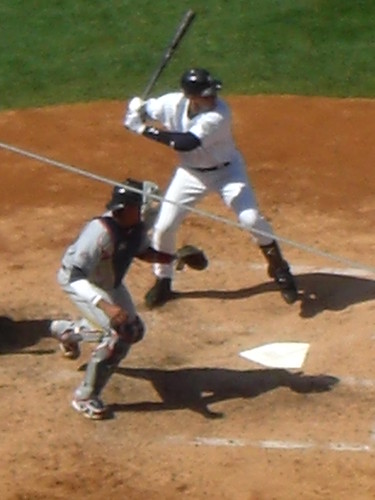 |
| This catcher correctly angles out and forward to receive the pitchout. (Photo by 2Eklectik) |
Timing. The timing of when to get up and angle out into the opposite batter's box is important as well. Too early may tip it off and too late defeats the purpose of a pitchout. It might vary based on each pitcher's delivery but the best time to start moving is when the pitcher's throwing hand starts to come forward in his delivery. That usually gets the ball and the catcher to arrive at the proper pitchout spot at the right time.
Saturday, January 29, 2011
Pitchout tips for pitchers
One of the things that pitchers and catchers rarely practice is pitchouts. Pitchouts can be very effective even if the runner does not steal. Obviously, if the runner goes the catcher has a better chance of throwing the runner out. Even if the runner doesn't go, it still puts the pitchout in the mind of runners and coaches in the future. For some, it might make them a little more tentative on stealing in the future if they know the potential for a pitchout exists.
Like everything else, pitch-outs are things that have to be practiced if they are to be successful. Mixing in a pitchout every five pitches or so when pitching and catching in the off-season is a great habit to get into. Here are some tips for pitchers on how to do it correctly in games and/or in practice:
Tomorrow's post: Pitchout tips for Catchers
Like everything else, pitch-outs are things that have to be practiced if they are to be successful. Mixing in a pitchout every five pitches or so when pitching and catching in the off-season is a great habit to get into. Here are some tips for pitchers on how to do it correctly in games and/or in practice:
- Don't tip it off. Smart runners will not go if they think a pitchout is coming. Your delivery needs to be the same as any other pitch. Quickening up your delivery is ok to a certain degree. Too much and you're letting the runner know something is up.
- Shake off a pitchout sign. Nobody shakes off a pitchout. That's why you do it. It's another way of convincing a runner and batter that a pitchout is not coming. Obviously, the catcher needs to be in on the "fake shake-off."
- Give the runner some time. Some pitchers are so anxious to get the ball to the catcher that they quick-pitch. Smart runners won't go on a "quick-pitch." You want the runner to steal on a pitchout so come set and wait a little before delivering so the runner has a chance to get his normal lead and be comfortable.
- Throw at "the batter's" chest. This is the toughest part for pitchers. They are so trained to throw low strikes that on a pitchout many throw it over the plate and/or too low. Imagine there is a batter in the other batter's box and try to hit this "batter" right in the chest. That helps the throw to be wide enough and high enough for the catcher to handle easily.
 |
| Give the runner every indication that the pitch won't be a pitchout. |
Tomorrow's post: Pitchout tips for Catchers
Monday, January 10, 2011
The importance of a good catcher
If you have not seen this article from espn.com, it's worth the time. Especially if you are a catcher or know someone who is. Click on the title. Below the picture are links to a few other sites that catchers and coaches might find useful.
Brent Mayne's Website : Brent Mayne is a 15 year MLB veteran who has a good, common sense approach to catching. The site has videos, a blog, tips, and a book to purchase.
Steve Ellis Catching Instruction: Another site that includes some good, basic instruction for any kid interested in catching.
Championship Productions - Catching Videos: A good listing of some of the more popular catching videos for purchase from Championship Productions.
Webball / Catching: A good site for catchers and coaches to learn technique and drills. Click around for every other position as well.
Catching 101: JUST ADDED! A good site recommended by a reader. Thanks!
 |
| (Photo: Howard Smith/US Presswire) As if Phillie fans needed another reason to love Carlos Ruiz |
Brent Mayne's Website : Brent Mayne is a 15 year MLB veteran who has a good, common sense approach to catching. The site has videos, a blog, tips, and a book to purchase.
Steve Ellis Catching Instruction: Another site that includes some good, basic instruction for any kid interested in catching.
Championship Productions - Catching Videos: A good listing of some of the more popular catching videos for purchase from Championship Productions.
Webball / Catching: A good site for catchers and coaches to learn technique and drills. Click around for every other position as well.
Catching 101: JUST ADDED! A good site recommended by a reader. Thanks!
Tuesday, December 14, 2010
Catching mistakes
With 12 days to go until Christmas, let’s go around the field and list four common mistakes I see at the high school level by position. First up ... Catching.
Too much movement before the pitch. Ever try throwing a dart at a moving dartboard? That would be tough, right? That’s why it’s so important for catchers to have as little movement as possible before the pitch. Give the sign, set your feet and the target, and then sit still. Big league catchers move a lot more than they used to – I think too much – but it is more understandable at that level because pitchers are more accurate and the fear of opponents stealing signs and/or location is greater. However, young pitchers need all the help they can get. Stay still!
Too much movement after the pitch. By this I mean body movement and glove movement. Simply put, more movement = less strikes called. If you set up in the strike zone and the pitch is in the strike zone there is no need to move beyond reaching for the ball to catch it. The only glove movement after the ball is caught should be towards your belly button and only an inch or two (framing). To do this, the glove has to beat the ball to the location. If the ball and glove get to the spot at the same time, the force of the ball will take the glove back and out of the strike zone. Beating the ball keeps you in control and keeps the ball in the strike zone.
Too quiet. A catcher needs to be heard. The whole game is in front of you and within your view. You are the on-the-field coach and traffic cop. There is a reminder to be said before every play. Say it. It’s ok to be soft spoken off the field but not on the field if you want to be a catcher.
Too lethargic. Catching is by far the most grueling position - physically and mentally - on the field. Click here if you need proof. However, catchers should not prove this fact to everyone by appearing worn out and miserable all the time. Run on and off the field, even if your bench is five steps from home plate. Make it obvious to all observers that there is no place on earth you’d rather be than behind the plate. Block every pitch in the dirt correctly even when no runners are on base. A scout might only see you for one inning. Show them all you’ve got. Most catchers don’t play this way. Most don’t play beyond high school either.
Tomorrow: 1st Base
Subscribe to:
Posts (Atom)